
You are reading this because your study permit was printed before November 8, 2024 and the condition still says you can work up to 20 hours per week off-campus, but every recent post you have seen mentions 24 hours and you want to know which one applies to you tonight when you pick up a shift.
The short answer: 24 hours. As of November 8, 2024, IRCC raised the off-campus work cap for eligible international students to 24 hours per week, and the new cap applies automatically to permits issued before that date. You do not need a re-issued permit. The 20 hours printed on your card is the old wording; the regulation is the law, and the regulation now allows 24.
This article answers the 12 follow-up questions the official IRCC off-campus work page does not consolidate in one place: how gig work hours are counted after the May 2026 clarification, what happens if you stack two part-time jobs plus DoorDash, which breaks count as scheduled breaks, and what to do tonight if you just realised you worked 27 hours last week. Every fact is dated to either the November 8, 2024 rule change or the May 2026 gig-work clarification, so you can verify each one against a current IRCC source.
The 24-Hour Off-Campus Work Rule in 2024 (and Why Your Permit Still Says 20)
The effective date is November 8, 2024 (IRCC announced the change on November 15, 2024, but the regulation came into force a week earlier). On that day, the off-campus work limit under paragraph 186(v) of the Immigration and Refugee Protection Regulations IRPR rose for eligible DLI students from 20 hours per week to 24 hours per week during the academic session. This is the current ongoing rule, not a sunset-dated temporary policy; IRCC can revise it through future regulatory amendments, but no expiry date has been published.
The rule is regulatory, not contractual. That means the moment the policy came into force, every eligible study permit, including the ones printed before November 8 with the old 20-hour wording, became subject to the new cap. IRCC stated plainly that no re-issuance is required. The printed condition on your permit is a snapshot of the policy on the day your permit was issued; the policy that governs your work today is the one in force today.
For a longer explanation of why the wording on your permit and the legal cap disagree, and what to show an employer who is skeptical, read our companion article on your study permit says 20 hours but the rule is 24. Bookmark it on your phone so you have a screenshot-ready answer.
The next question almost every student asks is whether the rule applies to them at all, since IRCC’s eligibility list quietly excludes several groups.
Who the 24-Hour Rule Applies To: The Full Eligibility Checklist
To work off campus under the 24-hour cap, you must meet all of the following:
- You are enrolled full time at a DLI (your school must be on IRCC’s designated learning institution list).
- Your program is at least six months long and leads to a degree, diploma, or certificate.
- You hold a valid study permit that includes a condition allowing off-campus work.
- You have a valid Social Insurance Number SIN.
- You are actively studying (not on a leave of absence and not between programs).
The off-campus work authorization does not apply to:
- Students whose only program is English or French as a Second Language (ESL/FSL).
- Students on a visiting or exchange basis (no Canadian credential issued).
- Students who have stopped actively studying for any reason other than an officially scheduled break.
Status continuity matters here. If your program ends and your completion letter is delayed past your study permit expiry, your work authorization can lapse before your PGWP starts. Our piece on the 180-day and 90-day PGWP window when your permit expires before the completion letter walks through that gap.
If you pass the eligibility check, the next question is the one most blogs get spectacularly wrong: gig work.
Does Gig Work Count? The Uber Eats, DoorDash, and Skip the Dishes Rule
Yes, gig work counts toward your 24 hours, but only the active hours, not the online hours. This was unclear for the first 18 months after the rule came in. In May 2026, IRCC issued a clarification: the hours that count are the paid or commission hours you actually worked, meaning active delivery time and accepted-order time, not the total time the app was open and you were waiting for a ping.
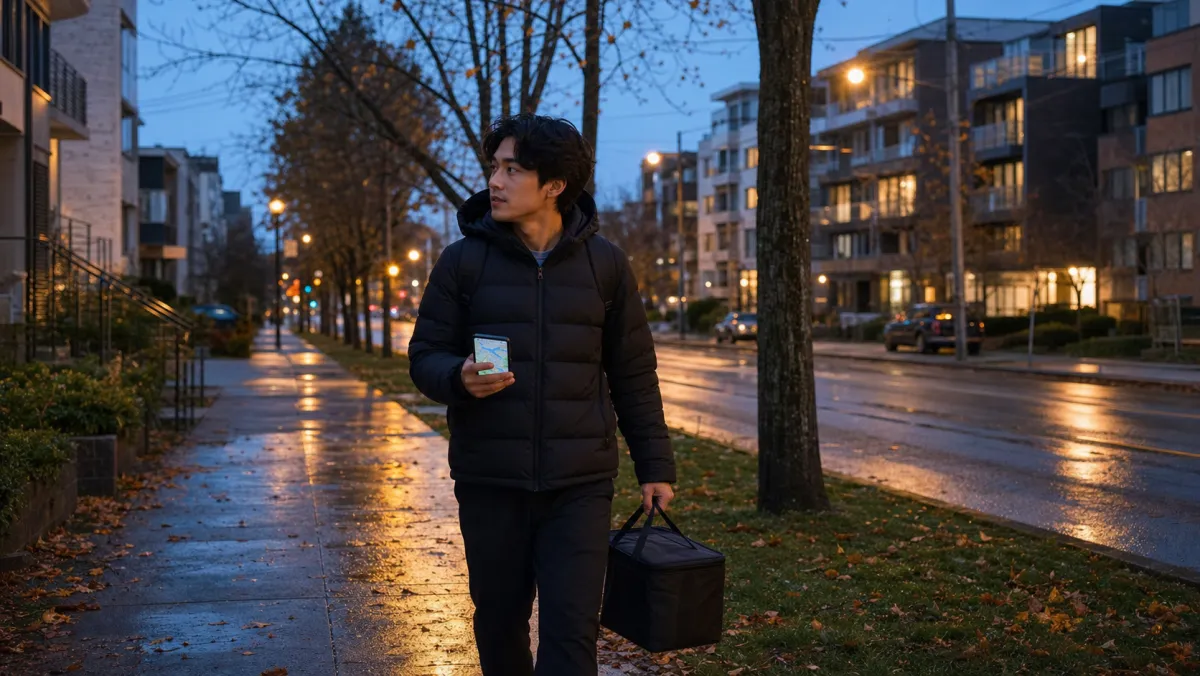
What this means in practice: if your DoorDash dashboard shows 28 online hours last week but only 19 of those hours were active (driving to a pickup, holding food, completing a drop-off), your reportable gig hours are 19. Stack 4 hours at a retail job on top and your weekly total is 23, inside the 24-hour cap.
The catch is that the gig platforms do not separate active hours and online idle time on the export they give you. You are responsible for self-tracking. A defensible log looks like this:
- Date: 2026-06-02
- Platform: DoorDash
- Active start to end: 18:14 to 22:47 (4 hours 33 minutes active across 6 deliveries)
- Total online time the app shows: 6 hours 12 minutes
- What counts toward the cap: 4 hours 33 minutes
For the full breakdown of the May 2026 clarification and how to set up your gig log, read does Uber online time count toward your 24 hours. It walks through the IRCC source and the DoorDash and Uber Eats export workflows step by step.
If you are stacking gig work on top of a retail or campus-adjacent job, the next section is the one you need to plan around.
Multiple Jobs and the 24-Hour Math (It Is Combined, Not Per Employer)
The 24 hours is a combined total across every off-campus job and gig platform you work. It is not 24 hours per employer. IRCC’s wording on the off-campus work page is explicit: you can have more than one off-campus employer, as long as the total off-campus hours stay within the cap.

A worked example: you have a 16-hour retail job from Wednesday to Saturday, and you do DoorDash on Sunday and Monday evenings. Sunday you log 4 active hours, Monday you log 4 active hours. Your total: 16 plus 8 equals 24. You are exactly at the cap, with zero margin for an extra shift swap.
The practical rule: build your schedule with a buffer. If you fill 24 hours every week with no slack, a single extra hour caused by a co-worker calling out, a long Friday close, or one extra DoorDash run after dinner pushes you over. A weekly target of 20 to 22 hours with a hard ceiling of 24 is what most students find sustainable.
If you do go over, talk to your employer the same week and drop the extra hours. Do not bank them and try to take fewer next week to average out; the cap is weekly, not monthly.
Per Day or Per Week? The Cap Is Weekly Aggregate
There is no daily cap. You can work 12 hours on a Saturday and zero hours on a Sunday and you are still within the rule, as long as the seven-day total is 24 or less.
IRCC does not define which day the week starts. In practice, pick a definition and stay consistent. Most employers use Sunday to Saturday or Monday to Sunday. Use whichever your largest employer uses on their pay stubs and apply the same window to your gig work. A consistent week boundary is what makes your log defensible if an officer ever asks.
One trap: do not let the absence of a daily cap pull you into a 14-hour Saturday shift. You can do it legally, but the academic consequences (you have to study Sunday) are real and the risk of misreading a long shift hour count is high. Plan in 4 to 8 hour shifts and you avoid both.
Scheduled Breaks: Which Ones Count for Unlimited Hours
During an officially scheduled break in your DLI’s academic calendar, you can work unlimited off-campus hours. This is where students get tripped up, because IRCC’s wording is specific.
A scheduled break is a break that appears in your school’s official academic calendar. The common ones:
- Winter break (mid-December to early January at most DLIs).
- Reading week (one week in February or March, depending on the institution).
- Summer term, if you are not enrolled in courses that term AND you were enrolled full time the term before AND you are enrolled full time the term after.
What does not count as a scheduled break:
- A week you took off on your own initiative.
- The gap between two programs at the same DLI (you are no longer actively studying).
- A term you dropped to part time to make room for more work (this kills your work authorization entirely; full-time enrolment is the gate).
The trap most students fall into: dropping a course at the end of a heavy term to lighten the load and then working 35 hours a week assuming it is a break. It is not a break, it is part-time enrolment, and part-time enrolment cancels the off-campus work authorization until you return to full-time status.
What Happens If You Work More Than 24 Hours
Working beyond the cap is a breach of the conditions on your study permit under IRPR. The consequences ladder, from least to most severe:
- An IRCC officer reviewing your file (extension, PGWP, or PR application) finds the breach and refuses the application.
- The officer finds you inadmissible for non-compliance with the conditions of your stay.
- A removal order is issued and you have to leave Canada.
In practice, a single small breach (you worked 26 hours one week last September) is rarely surfaced on its own. The risk is what surfaces it: a CRA T4 reconciliation that shows you earned more than 24 hours of pay per week at minimum wage, a CBSA exam at the border where an officer asks pointed questions, or, most commonly, a PGWP application where the officer pulls your tax slips and notices the mismatch.
The real exposure is your PGWP. The Post-Graduation Work Permit is the single most valuable document on your study permit to PR pathway, and an officer who sees a study permit condition breach can refuse it. There is no appeal that puts you back in the queue without significant cost.
What to do the moment you realise you went over: stop. Drop the extra hours this week. Talk to your employer and explain you are at the cap. Write a dated note for your own file describing what happened (scheduling error, a swap you agreed to, a miscounted DoorDash week). Do not repeat the breach. A future officer reviewing one documented isolated incident is in a very different situation from one reviewing a pattern.
Cash work is a separate, larger risk. If you are tempted to take cash to keep your hours invisible, read our piece on cash under the table on a study permit and the risk to your PGWP and PR first. Consult a licensed immigration consultant or lawyer for advice specific to your situation.
The Co-op Work Permit Question: Does the 24-Hour Cap Still Apply?
Co-op work permit hours are separate from off-campus work hours. If your program requires a co-op or internship component as part of the credential, you apply for a co-op work permit and the hours you work in that placement do not count toward the 24-hour off-campus cap.
The 24-hour cap still applies to any unrelated work you do outside the co-op. A common case: you are doing a full-time co-op placement Monday to Friday under your co-op work permit, and you take a weekend retail job for extra income. The weekend retail job is off-campus work and is capped at 24 hours per week, even though your co-op hours are uncapped.
Where students get confused: a paid internship that is NOT a required part of the program does not get a co-op work permit. It is just a job, and it counts against the 24-hour cap. Verify the credit on your transcript: if the placement appears as a graded course, it is co-op. If it does not, it is off-campus work.
How to Keep a Defensible Hours Log (Self-Employed and W2 Together)
Your log is what a PGWP officer or a CRA reviewer will ask for if anything is questioned. The standard is six years of records under CRA recordkeeping requirements. The format matters less than the consistency.

A weekly log that holds up:
- Week: 2026-05-25 to 2026-05-31 (define your week and use it consistently)
- Date: 2026-05-28
- Source: Tim Hortons (T4 employer)
- Start to end: 14:00 to 18:00
- Hours: 4.0
- Gross pay: $66 (from pay stub)
- Date: 2026-05-29
- Source: DoorDash (T2125 self-employed)
- Active hours: 3.5 (online time was 5.0, idle 1.5)
- Gross pay: $72 (from DoorDash weekly summary)
- Week total: 22 hours
The two reconciling records you need to keep alongside your log are your T4 slips (employer-issued) and your gig-platform tax exports (used to file a T2125 for self-employment income). Your pay stubs and gig summaries should match your log within rounding. If they do not, fix the log before the discrepancy compounds.
If you are PGWP-pending and an employer wants documentation of your hours and status, our breakdown of the six-document stack for PGWP-pending employer proof covers what to assemble.
This is not legal or tax advice. Consult a licensed immigration consultant, lawyer, or accountant for advice specific to your situation.
Stay Current as the Rule Changes
The 24-hour cap is the current regulation under IRPR, and IRCC has continued to refine how it applies in practice. The May 2026 gig-work clarification is one example of how the rule keeps getting tightened after the headline change. A rule you confirmed in January 2026 is not necessarily the rule today, so verify against the IRCC off-campus work page before any major decision.
Subscribe to the CanadaSmarts newsletter for monthly IRCC rule-change updates focused on study permit holders. You get a dated, plain-language summary of every change that affects your work authorization, PGWP eligibility, and PR pathway. No consultations, no upsells; just the same date-stamped, IRCC-grounded answers this article delivers, on a monthly cadence.
If you have not yet read our companion pieces, the two most-saved by other students are your study permit says 20 hours but the rule is 24 and does Uber online time count toward your 24 hours. Save both to your phone before your next shift.
Frequently Asked Questions
Can I work 24 hours a week on my study permit now that the rule changed in November 2024?
Yes. As of November 8, 2024, the off-campus work cap for eligible international students at a DLI is 24 hours per week during the academic session. The change applies automatically to existing study permits; you do not need a re-issued permit. See the official Canada.ca news release (published November 15, 2024) for the policy notice.
My study permit still says 20 hours. Does the November 2024 rule change apply to me automatically?
Yes. IRCC has confirmed the 24-hour cap auto-applies to study permits issued before November 8, 2024 that contain the off-campus work condition. The printed wording on your permit is from the day it was issued; the regulation that governs your work today is the post-November 8, 2024 rule. Carry a printout of the IRCC off-campus work page if an employer or border officer asks.
Does gig work (Uber Eats, DoorDash, Skip the Dishes) count toward the 24-hour work limit?
Yes, but only the active and paid hours. Per the May 2026 IRCC clarification, active delivery time and accepted-order time count toward the 24 hours. Online idle time (app open, waiting for an order) does not. You must self-track active hours because gig platforms do not break them out for you.
What happens if I work more than 24 hours on my study permit?
Working beyond the cap is a breach of your study permit conditions under IRPR. IRCC can find you inadmissible, refuse future PGWP or PR applications, or issue a removal order. A single small breach is rarely surfaced on its own, but it can surface in a CRA tax review or a CBSA exam and damage your PGWP application. Stop, drop the extra hours immediately, and document the cause.
Can I work full time during scheduled breaks (Christmas, Reading Week, summer) on my study permit?
Yes, during officially scheduled breaks in your DLI’s academic calendar. Winter break, reading week, and a summer term you are not enrolled in (when you were full-time the term before and after) qualify. A personal week off you took on your own does not.
I worked more than 24 hours by mistake. What do I do now?
Stop working over the cap immediately. Talk to your employer the same day and drop the extra hours. Write a dated note for your own file describing the cause (scheduling error, shift swap, miscounted gig hours). Do not repeat the breach. Clean records going forward show a future PGWP officer one isolated incident, not a pattern.
Do volunteer hours or unpaid internships count toward the 24-hour cap?
Genuine, unpaid volunteer work for a registered charity or non-profit, with no expectation of payment, does not count. Unpaid internships that would normally be paid (a position that displaces a paid worker) are considered work and do count. When in doubt, treat it as work and keep it under the cap.